Planning a wedding is one of the most exciting times in a family’s life, but let’s be honest—it’s also one of the most expensive. In many cultures, especially in South Asia, gold isn’t just a metal; it’s a sacred tradition, a status symbol, and a safety net wrapped into one. I’ve seen families panic as gold prices skyrocket right before the big day, scrambling to buy jewelry at peak rates. It doesn’t have to be that way. With a smart gold saving for a wedding in 2026 strategy, you can build a treasure trove without breaking the bank.
This guide isn’t just about buying jewelry; it’s about understanding the market, avoiding hidden costs, and making your money work for you. Whether you are a parent planning for your daughter’s future nuptials or a couple saving for your own special day, this is your roadmap.
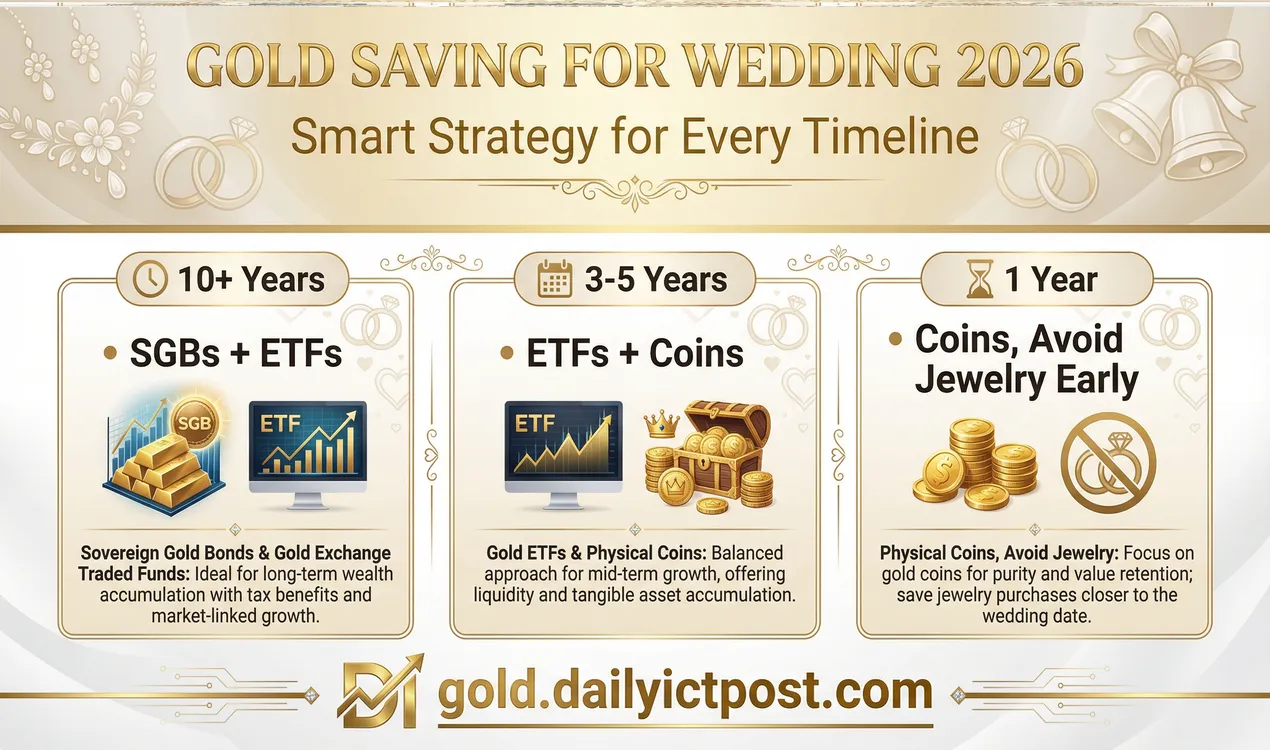
Quick Gold Saving Strategy for Wedding (2026)
• 10+ Years Away → Use SGBs + ETFs
• 3–5 Years Away → Mix ETFs + Coins
• 1 Year Away → Buy Coins, Avoid Jewelry Early
• Avoid → High Making Charges & Emotional Purchases
We often hear financial advisors say, “Diversify your portfolio,” but when it comes to weddings, gold is king. Why? Because gold investment for wedding purposes serves a dual role. It is the primary adornment for the bride and groom, and historically, it acts as a hedge against inflation.
Cultural Mandate: In many communities, the exchange of gold is a non-negotiable rite of passage.
Financial Security: Unlike flowers or catering, the money spent on gold remains with the family as an asset.
Liquid Asset: In times of crisis, gold can be liquidated faster than real estate or fixed deposits.
Understanding Your Timeline
The first question I ask anyone asking about saving gold for wedding expenses is: “How much time do you have?” Your strategy changes completely based on your horizon.
10+ Years (For a child): You have the luxury of time. You can take risks and use long-term bonds.
3-5 Years (Mid-term): You need a balance of growth and liquidity.
1 Year or Less (Immediate): You are in damage control mode. The focus is on minimizing wastage and making charges.
Setting a Realistic Gold Budget
Before you save, you must know what you are saving for. A vague goal like “buying gold” won’t work. You need a gold savings plan for wedding expenses that is specific.
Itemize the Requirements: List every necklace, ring, bangle, and earring needed.
Estimate the Weight: Assign a grammage to each item. For example, a heavy bridal set might be 80 grams.
Factor in Wastage: Always add 15-20% to your weight estimate for wastage and making charges.
The Inflation Factor: Note: Gold prices can fluctuate in the short term. While it has historically preserved purchasing power over long periods, it is not guaranteed to rise every year. If 10 grams costs $700 (or equivalent currency) today, assume it might cost $850 or more in a few years.
Method 1: Sovereign Gold Bonds (SGBs)
If you are looking for long term gold saving for wedding expenses, especially for a daughter who is still a child, Sovereign Gold Bonds are my top recommendation. These are government securities denominated in grams of gold.
The Interest Bonus: Unlike physical gold sitting in a locker, SGBs pay you an annual interest (often 2.5%) on your initial investment.
No Making Charges: You don’t lose money on making charges or purity testing.
Tax Benefits: If held until maturity, the capital gains tax is often zero.
Safety: There is no risk of theft or storage costs.
Method 2: Gold Exchange Traded Funds (ETFs)
For those who understand the stock market, gold for wedding planning can be done efficiently through ETFs. These are mutual fund schemes that invest in standard gold bullion (99.5% purity).
Liquidity: You can buy and sell units during stock market hours just like shares.
Purity Guarantee: Each unit is backed by physical gold of high purity.
SIP Friendly: You can start a Systematic Investment Plan (SIP) with very small amounts, averaging out the cost of gold over time.
Method 3: Digital Gold Apps
We live in a digital age, and gold savings strategy for wedding planning has evolved. Several apps allow you to buy gold for as little as $1.
Micro-Savings: This is perfect for those who can’t afford to buy a whole gram at once.
Instant Accumulation: Got a bonus at work? Put it into digital gold instantly.
Redemption: You can accumulate digital gold over years and then redeem it for physical coins or jewelry when the wedding date arrives (though making charges will apply then).
Method 4: Jeweler’s Monthly Schemes
You might have seen ads for “11+1” schemes. These are popular best gold saving plan for wedding options for short-term goals.
How it works: You pay a fixed installment for 11 months, and the jeweler pays the 12th installment or gives a discount.
The Catch: You are locked into buying from that specific jeweler. If you don’t like their designs later, you are stuck.
My Advice: Only use this if you are absolutely sure about the jeweler’s reputation and design variety.
Many people make the mistake of buying jewelry years in advance. This is a bad gold saving for future wedding strategy because designs go out of fashion. Instead, buy coins.
Lower Premiums: Coins have very low making charges compared to intricate necklaces.
Flexibility: You can sell the coin to any jeweler later to buy the latest designs.
Purity: It is easier to verify the purity of a coin than a studded necklace.
Is Gold Saving Good for a Wedding?
I get asked, “is gold saving good for a wedding or should I just save cash?” Here is the reality: Cash loses value. Inflation eats away at your savings account interest. Gold, on the other hand, preserves purchasing power. If you save cash for 5 years, you might find that the necklace you wanted has doubled in price, and your cash savings haven’t kept up. Saving in gold locks in the quantity of metal you can afford.
How to Save Gold for a Wedding:
Consistency is the secret sauce. A gold savings plan for wedding shouldn’t depend on “when I have extra money.”
Automate It:
Set up a monthly auto-debit for a Gold Fund or Digital Gold.
Rupee Cost Averaging:
By buying a fixed amount every month, you buy more units when prices are low and fewer when prices are high, averaging your cost.
Discipline:
It forces you to save before you spend.
Gold vs Cash Saving for Wedding
Let’s break this down further.
Cash: Safe but stagnant. Good for paying the caterer or venue, but bad for long-term asset building.
Gold: Volatile in the short term but robust in the long term.
Verdict: Keep your vendor payments in safe debt funds or cash, but keep your jewelry budget strictly in gold-backed assets.
Gold Saving for Wedding Jewelry: Purity Matters
When gold saving for wedding jewelry, you must understand Karats.
24K (99.9%): Pure gold. It’s too soft for jewelry but perfect for coins and bars.
22K (91.6%): The standard for wedding jewelry. It has a mix of copper, zinc, or silver to make it durable.
18K (75%): Used for diamond and stone-studded jewelry to hold the stones securely.
My Tip: Never pay 24K rates for 22K jewelry. Always check the daily rate for the specific purity.
Benefits of Long-Term Gold Accumulation for Weddings
If you start long term wedding gold planning strategy plans early, you benefit from the power of compounding (if invested in SGBs or Funds) and price appreciation.
Example: A parent who bought 100g of gold 10 years ago paid a fraction of what it costs today. They secured their child’s future for cheap.
Stress Reduction: You won’t be sweating over daily gold price fluctuations a month before the wedding because you already have your gold in the vault.
Gold Investment Benefits for Wedding
Beyond just having jewelry to wear, the gold investment benefits for wedding planning are immense.
Collateral: The gold you buy can be used to secure low-interest loans in the future for buying a house or business expansion.
Legacy: This gold becomes a family heirloom, passed down to grandchildren.
Portfolio Balance: It balances the risk if your other investments (like stocks) crash.
Gold Saving Mistakes to Avoid for Wedding
I’ve seen savvy savers lose money by making these errors:
Ignoring Making Charges:
Paying 25% extra for “intricate designs” is money you will never get back.
Buying Stone-Studded Gold:
When you sell, jewelers often deduct the weight of the stones and impurities. You lose value.
Not Checking Hallmarks:
Always insist on BIS Hallmarked (or equivalent authority) gold. It guarantees purity.
Emotional Buying:
Don’t let a pushy salesperson guilt you into buying more than your budget.
Gold Saving Plan for Daughter Wedding
For parents, a gold saving plan for daughter wedding is often an emotional journey.
Start at Birth: Open a dedicated gold savings account or SGB folio as soon as she is born.
Gift Gold: Ask relatives to gift gold coins instead of toys or clothes on birthdays.
Review Annually: As gold prices change, review if your savings rate is enough to meet the target weight.
Gold Savings for Wedding Budget Planning
Integrate gold savings for wedding budget planning into your overall financial map.
The 30% Rule: Many financial planners suggest that gold and jewelry should not exceed 30% of the total wedding budget.
Track Expenses: Use a spreadsheet to track how many grams you have accumulated versus how many you need.
Buffer Fund: Keep a small cash buffer for the “wastage” charges that invariably crop up during the final jewelry making.
Best Way to Save Gold for Marriage
In my experience, the best way to save gold for marriage is a hybrid approach.
50% in SGB: For the interest income and safety.
30% in Physical Coins: For the joy of holding the asset and easy conversion.
20% in Cash/Liquid Funds: To pay for the making charges (labor cost) of the final jewelry pieces.
Decoding Making Charges (Wastage)
This is the hidden killer in wedding gold saving tips. Making charges are the labor costs for crafting the jewelry.
Machine made: Usually cheaper (8-14%).
Hand made: More expensive (15-25%+).
Negotiation: You can rarely negotiate the gold rate, but you can always negotiate making charges. I’ve seen them dropped by 30-40% just by asking.
Buying Old Gold vs New Gold
One smart strategy is recycling.
Family Gold: Take your grandmother’s heavy, old-fashioned necklaces and have them melted and redesigned.
Cost Efficiency: You only pay for the labor (making charges). The gold itself is free!
Sentiment: It keeps the family history alive in a modern form.
The Role of Hallmarking
Never compromise on this. Hallmarking certifies the purity of the gold. In India, for example, look for the BIS logo, the purity grade (e.g., 22K916), and the 6-digit HUID code. Without this, you are buying on blind faith, and that is a terrible investment strategy.
Safe Storage Solutions
If you are accumulating physical gold, you have a security risk.
Bank Lockers: The traditional choice, but they come with annual fees and limited liability from the bank.
Home Safes: Only advisable if you have a high-security safe and comprehensive home insurance that specifically covers jewelry.
Digital Vaults: The provider stores the gold for you, often for free for a few years.
Tax Implications of Gold
Be aware of the taxman.
Wealth Tax: In some jurisdictions, holding gold above a certain limit attracts wealth tax.
Capital Gains: Selling physical gold after 3 years often attracts Long Term Capital Gains (LTCG) tax.
SGB Advantage: As mentioned, SGBs are often exempt from capital gains tax on redemption, making them highly tax-efficient.
Gold vs Diamond for Weddings
While diamonds are marketed as “forever,” their resale value is often poor compared to gold.
Resale: You can sell gold at the current market rate. Diamonds often fetch only 70-80% of their purchase price.
Upgrade: Diamonds are harder to upgrade or melt down.
My Advice: Stick to gold for the investment portion. Buy diamonds for consumption/luxury only if the budget permits.
Impact of Global Events
Gold is a global commodity. Wars, pandemics, and US Federal Reserve interest rate changes all impact the price.
Buy on Dips: Timing the market perfectly is difficult, so regular investing is often safer than waiting for the perfect price.
Don’t Panic: If gold prices drop right after you buy, don’t panic sell. It is a long-term hold.
The Groom’s Gold Requirements
We often focus on the bride, but the groom needs gold too. Chains, rings, and bracelets are common.
Simplicity: Men’s jewelry is usually simpler, meaning lower making charges.
Watch Out: Men’s chains are often heavy. Ensure you budget for this significant weight.
Checking Gold Purity Yourself
While you can’t do a lab test at home, there are basics.
Magnet Test: Real gold is not magnetic.
Acid Test: Jewelers use a touchstone and acid.
Caratometer: Most reputable shops have a machine that scans the gold to tell you the purity without damaging it. Always ask for a test before you buy.
Seasonal Buying Strategy
Gold prices in local markets often spike during wedding seasons and festivals like Diwali or Akshaya Tritiya due to high demand.
Contrarian Approach: Buy your gold during the “off-season” (often mid-year or post-wedding season) when demand is sluggish. You might get better deals on making charges.
Leveraging Credit Cards (With Caution)
Some people use credit cards to buy gold to get reward points.
The Trap: If you can’t pay the bill in full next month, the interest rate (30-40%) will wipe out any gold appreciation.
The Win: If you are disciplined, the reward points can essentially give you a small discount on the purchase.
Conclusion
Gold saving for a wedding is more than just a financial transaction; it is a labor of love and foresight. It bridges the gap between our cultural heritage and our modern financial reality. By starting early, choosing the right instruments like SGBs or coins, and being vigilant about hidden costs like making charges, you can ensure that your wedding day shines bright without casting a shadow on your financial future. Remember, the goal is to start your married life with an asset, not a debt. Plan smart, buy wise, and let your gold investment be a blessing for generations to come.
Frequently Asked Questions (FAQs)
1. What is the smartest gold saving plan for a wedding?
The smartest plan combines safety and growth. I recommend a mix: 50% in Sovereign Gold Bonds (for interest and tax benefits) and 50% in physical coins or digital gold for liquidity. This ensures you beat inflation while having gold ready for the big day.
2. Is gold saving good for a wedding if I have little money?
Yes, absolutely. Is gold saving good for a wedding on a budget? Yes, because you can start with fractional investments. Digital gold apps allow you to invest as little as $1 or ₹100. Over a few years, these small drops fill the bucket.
3. How do I avoid high making charges?
To avoid high making charges, buy simple designs or solid gold coins/bars which have minimal wastage. Save the intricate jewelry purchases for the very end, and negotiate hard on the labor cost, not the gold rate.
4. Can I sell digital gold for cash for my wedding?
Yes, you can sell digital gold back to the platform at the current sell rate. However, there is usually a “spread” (difference between buy and sell price) of about 3-6%, so factor that into your calculations.
5. What are the common gold saving mistakes to avoid for a wedding?
The biggest gold saving mistakes to avoid for wedding planning are: buying jewelry too early (fashion changes), ignoring the purity (hallmark), and storing gold insecurely at home without insurance.
6. Is 22K gold better than 24K for weddings?
For jewelry, yes. 22K is durable enough to hold its shape. 24K is too soft and will bend or break easily. However, for investment (coins/bars), 24K is better as it is pure gold.
7. How much gold is enough for a wedding?
There is no one-size-fits-all answer. It depends on your community traditions and personal budget. Don’t go into debt to meet societal expectations. A common range is anywhere from 50 grams to 500 grams depending on affordability.
8. Should I take a loan to buy gold for a wedding?
I strongly advise against taking a personal loan to buy gold. The interest rate on the loan (often 10-15%) is usually higher than the annual appreciation of gold. It creates a debt trap. Save first, buy later.
9. How does inflation affect my wedding gold budget?
Inflation drives gold prices up. If you budget $5000 for gold today, that same amount of gold might cost $6000 in two years. This is why saving in gold (or gold-linked assets) is safer than saving in cash.
10. What documents do I need to buy high-value gold?
For large purchases (e.g., over ₹2 Lakhs in India or $10,000 in the US), you typically need to provide KYC documents like a PAN card, Tax ID, or Passport to comply with anti-money laundering laws.
If this guide helped you plan smarter, consider sharing it with someone preparing for a wedding.
The author at gold.dailyictpost.com focuses on educational research related to the global gold market and long-term economic trends. Their work is centred on explaining how gold prices behave over time and how broader economic factors such as inflation, interest rates, and central bank policies influence the gold market.
Rather than offering investment advice, the author analyses historical data, publicly available economic reports, and well-documented market behaviour to help readers understand gold as a financial asset. The goal is to make complex financial topics easier to understand using clear language and real-world context.
The author’s writing approach is research-driven and neutral. Articles are written to inform, not to persuade. No content is intended to encourage buying, selling, or holding any specific asset. All discussions remain educational and are framed around historical trends and widely accepted economic principles.
gold.dailyictpost.com maintains editorial independence. The author does not promote paid investment schemes, financial products, or brokerage services. Any advertisements displayed on the website are handled by third-party networks and do not influence editorial decisions.
Readers are encouraged to use the information provided as a learning resource and to consult licensed financial professionals before making any financial decisions.