If you were watching the markets this past Tuesday, you likely did a double-take. In a move that caught even veteran traders off guard, gold prices surged after a large one-day rise since 2008, shattering recent resistance levels and reigniting the global conversation about safe-haven assets. It wasn’t just a good day for gold; it was a historic one. We witnessed a massive rebound that erased previous losses in the blink of an eye, sending spot gold prices skyrocketing to nearly $4,913 per ounce.
This wasn’t a standard market fluctuation. This was a statement. The gold prices surge since 2008 narrative is now front and center, driven by a perfect storm of political announcements, technical positioning, and raw market psychology. Whether you hold physical bullion, ETF shares, or mining stocks, understanding the mechanics behind why gold prices surged after a large one-day rise since 2008 is critical for navigating the weeks ahead. Let’s dive into the details of this record-breaking rally and explore what it means for your portfolio.
Gold Prices Surge After Largest One-Day Rise Since 2008 – Quick Answer
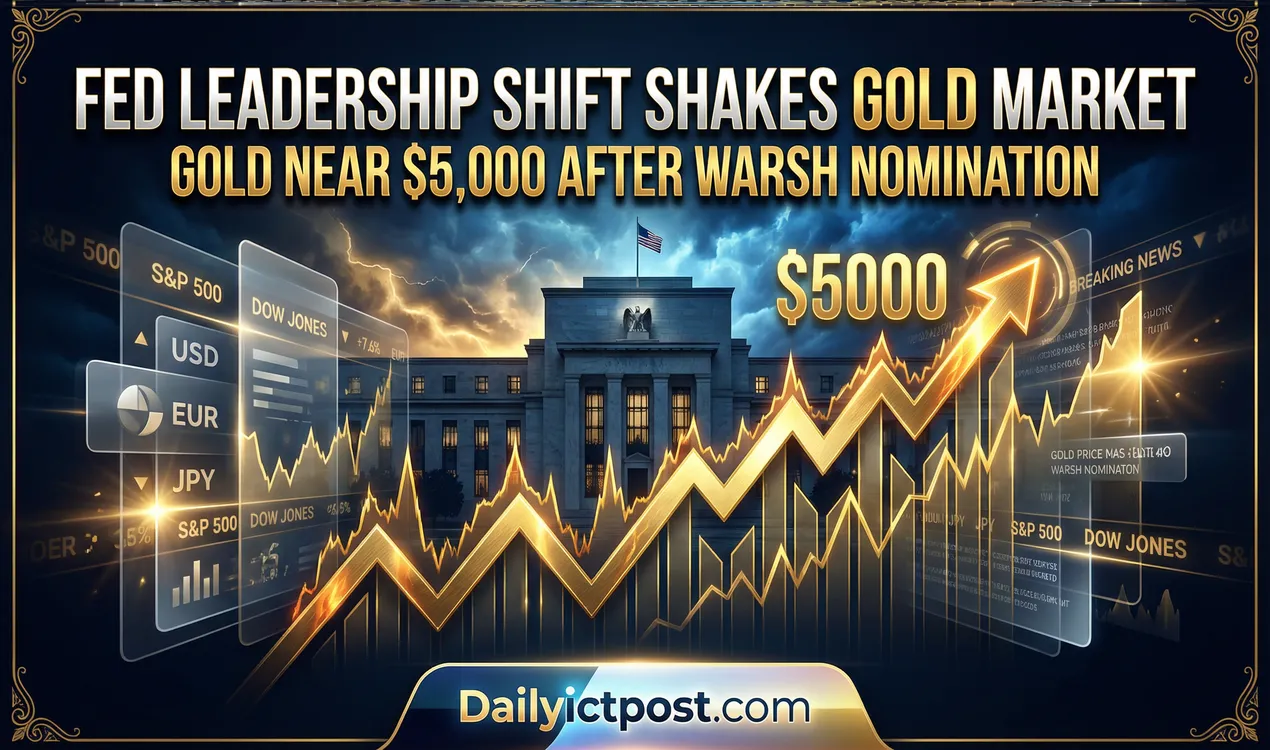
In 2026, gold prices surged over 5% in a single day—the biggest one-day rise since 2008—after heavy dip-buying and uncertainty around US Federal Reserve leadership. Spot gold jumped to nearly $4,913 per ounce, erasing recent losses. The rally was driven by short-covering, central bank demand, and safe-haven buying. Analysts now see $5,000 as the next key psychological level.
Gold Prices Surged After a Large One-Day Rise Since 2008
The largest single-day gold rally since the 2008 crisis
To truly grasp the magnitude of this event, we have to look at the context. Just days prior, gold was facing significant selling pressure. Then, in a sudden reversal, we saw the gold biggest one day rise since 2008. The metal climbed over 5% in a single trading session. To put that in perspective, assets like gold usually move in fractions of a percent. A move of this size indicates a massive shift in sentiment, where big money players—hedge funds, central banks, and institutional investors—all rushed through the same door at the same time.
The data behind the move is compelling. When gold price jumps highest since 2008, it signals that the market was heavily oversold. Traders call this a “coiled spring.” The price had been pushed down so far and so fast that when the pressure released, it exploded upward. This wasn’t just about buying; it was about panic buying from those who were short the market, fueling a gold prices spike one day rally that left bears scrambling to cover their positions.
Gold Market Surge Historic Rally
You might be asking, what exactly sparked this fire? While market mechanics played a role, the primary catalyst was political. The sudden nomination of Kevin Warsh for Federal Reserve Chairman by President Trump sent a jolt through the financial system, causing a gold market surge historic rally. Markets hate uncertainty, but they love the prospect of easy money. Warsh is viewed by many as a dove—someone who might favor lower interest rates or a weaker dollar to stimulate growth—but he also brings a reputation for wanting to tighten the Fed’s balance sheet.
This mixed signal created confusion, and when confusion hits, money flows to safety. We saw gold prices record daily gain numbers because investors started hedging against potential policy errors. If the Fed gets it wrong, inflation could spiral, or the economy could stall. In either scenario, gold shines. This is why we are seeing a gold price rally since financial crisis comparisons; the level of anxiety regarding central bank policy is reminiscent of that tumultuous era.
A Tale of Two Crises: 2008 vs. 2026
It is impossible to discuss this week’s action without looking back at history. The phrase gold prices surged after a large one-day rise since 2008 naturally invites a comparison to the Great Financial Crisis. Back then, the banking system was on the brink of collapse, and trust in paper currency was evaporating. Today, the drivers are different, yet the market reaction is eerily similar. We are seeing gold prices soar amid market uncertainty, not because banks are failing, but because geopolitical tensions and monetary policy shifts are creating a fragile environment.
Then (2008): Systemic credit freeze, Lehman Brothers collapse, panic selling across all asset classes followed by a rush to gold.
Now (2026): Algorithmic trading exacerbating moves, geopolitical instability, and a “regime change” at the Federal Reserve.
Both periods resulted in a gold safe haven rally since 2008, proving that gold’s role as the ultimate insurance policy remains intact.
One of the most fascinating aspects of this rally was the speed of the recovery. As soon as prices dipped to the $4,400 range, buyers stepped in aggressively. This is a classic case where gold hits biggest daily gain in years because smart money identified a value disconnect. Institutional investors have algorithms programmed to buy at key support levels, and when those kicked in, it created a domino effect.
The gold prices surge after market shock phenomenon is often driven by FOMO—Fear Of Missing Out. Once the price started ticking up, momentum traders jumped on the bandwagon, chasing the trend. This “dip buying” mentality is powerful. It suggests that despite the high prices, the market believes the long-term trend is still upward, and any correction is viewed as a gift rather than a warning.
Gold Price Volatility Historic Surge
Many investors fear volatility, but in the precious metals market, volatility often precedes a new trend. The gold price volatility historic surge we just witnessed is likely the start of a new chapter, not the end of one. When an asset class moves this violently, it wakes up sleeping capital. Investors who had ignored gold for years are now paying attention, wondering if they should allocate capital to the sector.
If gold prices break records since 2008 in terms of daily percentage gains, it acts as a marketing beacon. It draws in retail investors and generalist funds that typically stick to stocks and bonds. This influx of new capital can sustain the rally far longer than the initial short-squeeze, leading to a scenario where gold prices rise sharply global markets continue to support the trend.
Gold Prices Surged After a Large One-Day Rise Since 2008
Gold doesn’t exist in a vacuum. When gold prices surged after a large one-day rise since 2008, it sent ripples through the entire commodity complex. Silver, often seen as gold’s more volatile sibling, surged nearly 9% on the same day. Platinum and palladium also posted gains. This tells us that the move was broad-based. It wasn’t just a quirk in the gold market; it was a sector-wide re-rating.
The gold market reacts with massive surge dynamics often pull other tangible assets up. Investors are essentially saying, “I want to own things that are real.” In a world of digital derivatives and fiat currency, the tangibility of precious metals becomes their biggest selling point during times of stress. The gold price surge analysis confirms that this correlation between gold and silver is healthy and indicates a robust bull market.
Technical Analysis: Clearing the Hurdles
For the chart watchers out there, the technical damage repaired on Tuesday was significant. By reclaiming the $4,858 level, gold negated a bearish breakdown. The gold prices rally strongest in decade technical formations are now back in play. We are looking at a classic “V-shaped” recovery, which is one of the most bullish patterns in technical analysis.
Support Reclaimed: The $4,400 zone held firm, proving there is massive demand at that level.
Resistance Broken: Slicing through $4,800 like butter showed the strength of the buyers.
Next Targets: All eyes are now on the psychological $5,000 barrier.
The gold price surge explained through charts shows that momentum indicators like the RSI (Relative Strength Index) have reset and are pointing higher.
Why Central Banks Are Still Buying
You cannot talk about the gold market without mentioning the whales: Central Banks. Nations like China, Turkey, and Poland have been relentless buyers of bullion. They are not trading for a quick profit; they are accumulating for generational security. Gold recorded its biggest one-day jump since 2008 in part because the floor is higher due to this official sector buying.
When gold prices jump on economic fears, central banks feel validated in their strategy to diversify away from the US dollar. They are playing a long game. Their continued accumulation reduces the available supply in the open market, making gold prices spike one day rally events more likely because there is simply less physical metal available to meet sudden spikes in demand.
The Dollar Dynamics
The relationship between the US Dollar and gold is crucial. Typically, a strong dollar hurts gold, and a weak dollar helps it. The recent gold market surge historic rally implies that the market is sniffing out future dollar weakness. With a new Fed Chair potentially looking to lower rates or adjust inflation targets, the dollar could lose some of its purchasing power.
Investors are front-running this possibility. If the dollar index breaks down, gold prices record daily gain streaks could become the new normal. It is a hedge against the debasement of fiat currency, a role gold has played for thousands of years.
Investment Strategies for the New Normal
So, how do you position yourself now that gold prices surged after a large one-day rise since 2008? Chasing a vertical rally can be dangerous, but staying on the sidelines might be worse.
Dollar Cost Averaging: Instead of going all-in, buy a fixed amount regularly. This smooths out the gold price volatility historic surge.
Diversify Your Holdings: Don’t just buy coins. Look at ETFs for liquidity and mining stocks for leverage. Mining stocks often outperform when gold prices break records since 2008.
Watch the Pullbacks: If gold dips back to the $4,700 or $4,800 level, that might be your entry point.
Remember, when gold prices rise sharply global markets are signaling a shift. Align your portfolio to benefit from this trend rather than fighting it.
Silver: The High-Octane Play
If gold is the steady defender, silver is the aggressive striker. As gold safe haven rally since 2008 narratives take hold, silver often outperforms on a percentage basis. We saw this on Tuesday with silver’s massive 9% jump.
For investors with a higher tolerance for risk, silver offers a way to leverage the gold prices jump on economic fears. However, be warned: silver can fall just as fast as it rises. It requires a stronger stomach than gold investing.
Risks to the Rally
No market goes up in a straight line forever. While gold market reacts with massive surge positively, there are risks. If the geopolitical situation suddenly resolves, or if the Federal Reserve comes out with a surprisingly hawkish stance (raising rates), gold could sell off.
Investors need to stay nimble. The gold price surge analysis suggests the trend is up, but external shocks can always derail the momentum temporarily. Always use stop-losses if you are trading short-term.
Gold Biggest One-Day Rise Since 2008 Explained
Is $6,000 realistic? Major banks seem to think so. J.P. Morgan and others have issued bullish forecasts that make the current price look like a bargain. The fact that gold prices rally strongest in decade now provides a strong technical base for a run to these higher levels.
If inflation remains sticky and central banks continue to buy, the gold price surge explained by fundamental supply and demand deficits points towards significantly higher prices in the next 12 to 24 months.
Conclusion: A Wake-Up Call for Investors
The event where gold prices surged after a large one-day rise since 2008 serves as a wake-up call. It is a reminder that in the financial world, things change slowly, and then all at once. The stability of the past decade is giving way to a new era of volatility and opportunity.
Whether you view gold as a crisis hedge or a capital appreciation play, the gold prices surge since 2008 confirms that the bull market is alive and well. The market has spoken, and it is saying that tangible assets are essential in a portfolio. Keep your eyes on the charts, stay informed on Fed policy, and consider how you can protect your wealth as gold prices surge after market shock ripples through the economy.
Visit Daily ICT Post for more updates on financial markets and technology.
Frequently Asked Questions (FAQ)
1. Why did gold prices surge after a large one-day rise since 2008? The surge was triggered by a mix of heavy “dip buying” after a sell-off, and the nomination of Kevin Warsh as Fed Chair, which introduced uncertainty about future monetary policy, causing a gold prices spike one day rally.
2. Is it too late to invest after the gold biggest one day rise since 2008? Not necessarily. Many experts view this as the beginning of a new leg up. While short-term pullbacks are possible, the long-term trend remains bullish as gold prices soar amid market uncertainty.
3. How high can gold prices go in 2026? Analysts are targeting $5,200 in the short term and up to $6,000 by year-end. The momentum from when gold hits biggest daily gain in years supports these higher targets.
4. What does “oversold” mean regarding the gold price surge analysis? It means sellers were exhausted. The price had dropped too far below its average value, making a rebound highly likely. This technical condition fueled the gold price volatility historic surge.
5. Did other metals rise when gold prices rise sharply global markets? Yes. Silver jumped nearly 9%, and platinum also saw gains. The gold market reacts with massive surge often lifts the entire precious metals complex.
6. How does the 2008 crisis compare to the gold safe haven rally since 2008? In 2008, it was a banking collapse. In 2026, it is geopolitical and monetary uncertainty. However, in both cases, investors rushed to gold to protect their wealth, leading to gold prices break records since 2008.
7. What is the best way to buy gold during a gold prices jump on economic fears? Physical gold coins and bars offer direct ownership. Gold ETFs (Exchange Traded Funds) offer liquidity. Mining stocks offer leverage. Choose the vehicle that fits your risk tolerance when gold prices rally strongest in decade.
8. Will the Kevin Warsh nomination continue to affect gold? Likely yes. His policy decisions will be scrutinized. If he leans towards easy money, it validates the gold price surge explained by currency debasement fears.
9. Is gold better than Bitcoin in this scenario? Gold has a longer history of stability. While Bitcoin is digital gold, the physical metal is preferred by central banks and conservative investors during a gold market surge historic rally.
10. What should I watch for next? Watch the $5,000 psychological level. Breaking that would be a significant milestone and could trigger another round of buying similar to when gold prices record daily gain this week.
Please don’t forget to leave a review of my article.
The author at gold.dailyictpost.com focuses on educational research related to the global gold market and long-term economic trends. Their work is centred on explaining how gold prices behave over time and how broader economic factors such as inflation, interest rates, and central bank policies influence the gold market.
Rather than offering investment advice, the author analyses historical data, publicly available economic reports, and well-documented market behaviour to help readers understand gold as a financial asset. The goal is to make complex financial topics easier to understand using clear language and real-world context.
The author’s writing approach is research-driven and neutral. Articles are written to inform, not to persuade. No content is intended to encourage buying, selling, or holding any specific asset. All discussions remain educational and are framed around historical trends and widely accepted economic principles.
gold.dailyictpost.com maintains editorial independence. The author does not promote paid investment schemes, financial products, or brokerage services. Any advertisements displayed on the website are handled by third-party networks and do not influence editorial decisions.
Readers are encouraged to use the information provided as a learning resource and to consult licensed financial professionals before making any financial decisions.