If you checked your investment apps this past Friday, you likely felt that sudden drop in your stomach. It wasn’t just a bad day; it was a massacre. We watched gold prices free-fall in a way we haven’t seen in years. Everyone is asking the same question: Is the bull market over? The massive fed chair nomination gold market reaction has shaken investors to their core. Let’s sit down and talk about what really happened, why Kevin Warsh scares the “easy money” crowd, and how you should navigate this storm without losing your shirt.
Quick Market Summary
Gold prices crashed after Kevin Warsh was nominated as Fed Chair due to fears of higher interest rates and a stronger dollar. The market had positioned for easy money, but a hawkish Fed outlook triggered panic selling. While short-term volatility remains high, long-term gold fundamentals like debt and inflation remain intact.
We all knew a change was coming. The tension between the administration and Jerome Powell was no secret. But when the news finally broke that Kevin Warsh was the pick to lead the Federal Reserve, the market didn’t just react—it panicked.
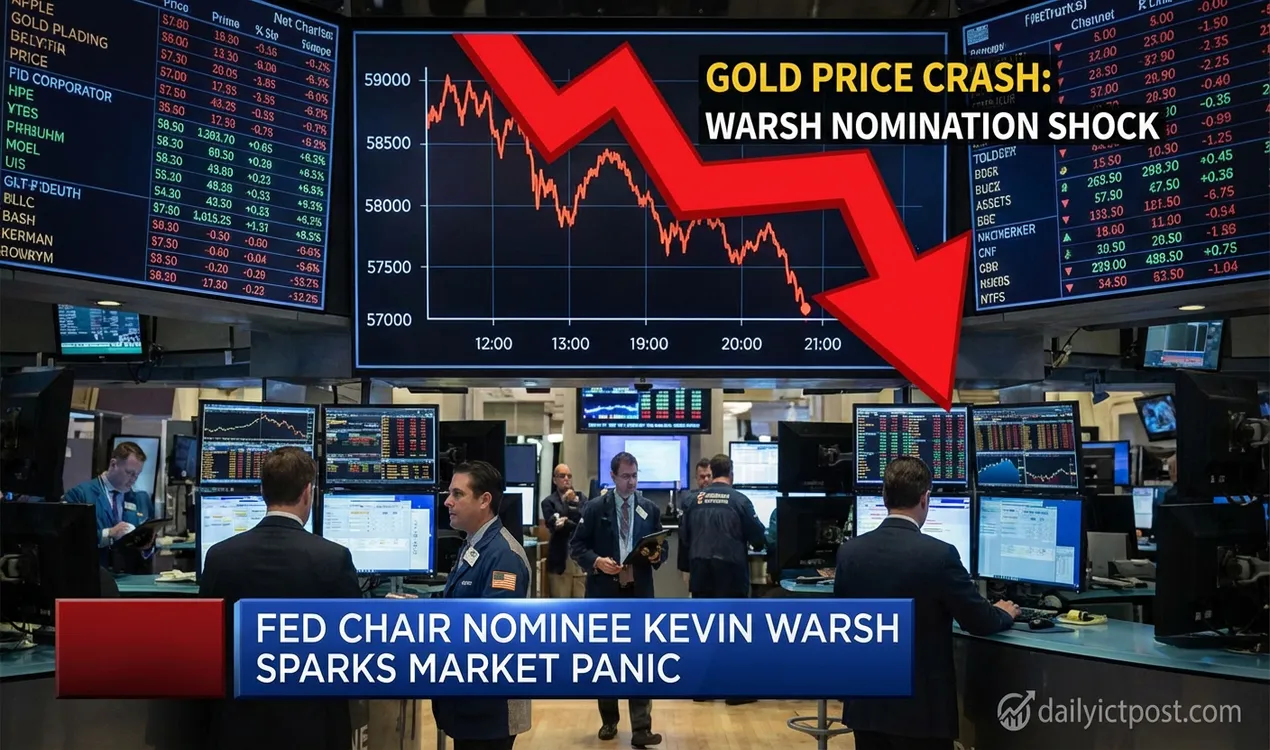
This wasn’t a standard correction. It was a violent repricing of risk. The gold market reaction to fed chair nomination news was immediate. Traders who had been betting on a dovish leader—someone who would keep interest rates low and money printing high—were caught completely offside. The result? A rush for the exits that wiped out billions in value in a matter of hours.
To understand the panic, you have to understand the man. Kevin Warsh isn’t your typical academic central banker. He is a former Fed Governor with a background on Wall Street, and more importantly, he has a history of being a “hawk.”
In financial speak, a hawk is someone who hates inflation more than they love high stock prices. The fed chair nomination impact on gold stems directly from this reputation. Investors fear Warsh will prioritize a strong dollar and sound money over bailing out the markets. This is a sharp U-turn from what the market was expecting, and uncertainty is the one thing markets hate more than bad news.
The Numbers Don’t Lie: A Historic Plunge
Let’s look at the damage. It wasn’t just a small dip. The gold prices after fed chair nomination crashed from near-record highs of around $5,600 straight down to the $4,800 level. That is a drop of roughly $800 in a single trading session.
Gold: Down over 14%. This wiped out weeks of steady gains.
Silver: The carnage was even worse here. Silver plunged nearly 30%, falling from $121 to $77.
Mining Stocks: The GDX and other mining indices looked like a sea of red, with many major producers down double digits.
This level of gold market volatility fed chair nomination induced selling is rare. It reminds veterans of the 1980s or the 2013 “Taper Tantrum.” When the narrative shifts this quickly, algorithms and margin calls exacerbate the move, pushing prices lower than logic would dictate.
Why Does a “Hawk” Hurt Gold?
You might be wondering, why does one man’s nomination crash a global asset? It comes down to the relationship between gold and interest rates.
Gold pays you nothing to hold it. No dividends, no interest. When interest rates are high, bonds and savings accounts become more attractive because they pay you a yield. If Warsh is expected to keep rates higher for longer to fight inflation, the fed chair nominee gold price reaction is naturally negative. Investors sell their non-yielding gold to buy yielding dollars or bonds. It is a competition for capital, and right now, the dollar is winning.
The “Trump Trade” Unravels
For the last few months, the “Trump Trade” was the dominant theme. The belief was that the new administration would want a weaker dollar to help exports and lower rates to boost the economy. Investors piled into gold expecting this easy-money environment.
The Warsh pick flips that script. It suggests a focus on discipline rather than stimulus. The gold market response to fed chair news was essentially the sound of millions of traders realizing they made the wrong bet. They had to unwind leveraged positions immediately, leading to a cascade of selling.
Silver: The High-Beta Victim
Poor silver. It always moves faster and further than gold, both up and down. While the fed leadership nomination gold impact was severe, silver’s crash was catastrophic. Because the silver market is smaller and less liquid, when big players want out, the door isn’t big enough. Prices gap down.
If you are holding silver, this hurts. But remember, silver is also an industrial metal. Its price is driven by factory demand, not just monetary policy. This panic selling might have pushed it into “oversold” territory, creating a potential opportunity for the brave.
Is the Safe Haven Status Broken?
A common question right now is: “I thought gold was a safe haven? Why is it crashing?” This is a classic misunderstanding of how gold as safe haven after fed chair nomination mechanics work during a liquidity crisis.
When panic hits, cash is king. Hedge funds and big institutions face “margin calls”—demands from brokers to put up more cash to cover losing bets. To raise that cash, they sell their most liquid assets. Gold is very liquid. So, in the initial phase of a shock, gold often falls alongside stocks. It is not that gold has stopped being a safe haven; it is just being used as a source of ready cash.
The Dollar Wakes Up
The US Dollar Index (DXY) shot up like a rocket on the news. A stronger dollar makes gold more expensive for anyone buying with Euros, Yen, or Yuan. This currency effect is a massive driver of the gold price reaction fed chair announcement.
If Warsh defends the dollar, the currency could enter a new bull run. That would be a headwind for gold prices in the medium term. You need to keep a close eye on the DXY chart; if it keeps climbing, gold will struggle to find its footing.
Technical Analysis: The Chart is Ugly
We have to be honest—the technical damage is real. The drop smashed through key support levels that traders were watching. The $5,000 level was a major psychological floor, and we sliced right through it.
According to fed chair nomination gold analysis, the next major support zones are much lower. Technical traders will look at this broken chart and likely wait for a “base” to build before buying back in. We need to see prices stop falling and trade sideways for a bit to regain confidence.
The Psychological Toll on Investors
Investing is 90% psychology. The fed chair nomination uncertainty gold rally that we saw prior to this was driven by FOMO (Fear Of Missing Out). Now, we have shifted to FEAR.
Panic Selling: Retail investors often sell at the bottom because the pain of loss is too great.
Capitulation: This is when the last bull gives up. We might be close to this point.
The Rebound: unexpected news often creates a “V-shaped” recovery once the initial shock wears off.
Understanding how fed chair nomination affects gold prices psychologically gives you an edge. The crowd is panicked. The smart money is calculating.
What Are the Central Banks Doing?
Don’t forget the whales. Central banks, especially in China and the Global South, have been buying gold hand over fist to diversify away from the dollar. Do you think they stopped because of Kevin Warsh?
Likely not. In fact, the gold price moves after fed chair nomination might be a gift to them. They can now buy the same tons of gold for 15% less than they could last week. If central bank buying data remains strong, this dip will eventually get bought up, putting a floor under the price.
The Inflation Argument Remains
Here is the thing: changing the Fed Chair doesn’t magically fix the US debt of $36 trillion. The fed chair nomination inflation gold impact discussion is still relevant. Even if Warsh wants to be a hawk, the math is against him.
The US government cannot afford massively high interest rates forever—the interest payments on the debt would consume the entire budget. Eventually, the Fed may be forced to print money regardless of who is in charge. This is the long-term thesis for gold, and it hasn’t changed one bit.
Navigating the Volatility: A Survival Guide
So, what do you do now? The gold market volatility fed chair nomination has created is dangerous, but also full of potential.
Don’t Panic: If you own physical gold, you still own the same number of ounces. The price on the screen has changed, but the asset hasn’t.
Check Your Leverage: If you are trading with borrowed money, be very careful. Volatility can wipe you out. Reduce your position size.
Watch the 10-Year Yield: If bond yields keep spiking, gold will remain under pressure. If yields stabilize, gold can recover.
Outlook: The Road Ahead for Gold
The fed chair nomination gold outlook is cloudy for the next few weeks. We need to hear Warsh speak. We need to see if the Senate confirms him easily. We need to see if the economy starts to crack under the expectation of tighter money.
However, many analysts believe the fed chair change gold forecast will eventually turn bullish again. Why? Because the system is addicted to cheap money. If Warsh tries to be too tough, he might break something (like the banking sector), forcing the Fed to pivot back to cutting rates. And when they pivot, gold usually flies.
Buying the Dip? Read This First
Is this a buying opportunity? The fed chair nomination market impact on gold has created a discount, no doubt. But catching a falling knife is risky.
Wait for Stability: Let the price settle for a few days.
Dollar Cost Average: Don’t go “all in” at once. Buy a little now, and more if it drops further.
Focus on Quality: Stick to physical bullion or high-quality mining stocks with strong balance sheets.
The “Fed Chair Nomination Explained Gold Investors” Summary
To wrap it up simply: The market expected a soft, easy-money Fed Chair. They got a hard-money hawk. They freaked out.
This fed chair nomination explained gold investors panic is a rational reaction to a change in the rules of the game. But history shows us that initial reactions are often overdone. The world is still messy, debt is still high, and gold is still the ultimate insurance policy.
Questions & Answers: Clearing the Confusion
1. Why did gold drop so fast just because of a nomination? Markets hate surprises. Investors were positioned for a specific outcome (a dovish Chair). When Warsh (a hawk) was named, everyone tried to exit those positions at the exact same time, causing a liquidity crunch and a massive price drop.
2. Is Kevin Warsh actually bad for the economy? It depends on who you ask. Supporters say he will bring much-needed discipline and fight inflation. Critics fear he could keep rates too high, potentially causing a recession or a stock market crash.
3. Will gold prices go back up to $5,000 soon? It is possible, but it might take time. The market needs to “digest” this news. We need to see stabilization in the dollar and bond yields first. A V-shaped recovery is possible if economic data weakens.
4. How does the “fed chair nomination gold market reaction” affect physical gold buyers? For physical buyers, this is actually good news. You can now buy coins and bars at a significantly lower price than last week. The premiums might rise slightly due to demand, but the spot price is lower.
5. What is the difference between a Hawk and a Dove? A Hawk (like Warsh is perceived to be) wants higher interest rates to stop inflation, which is often bad for gold. A Dove wants lower rates to stimulate jobs, which is usually good for gold.
6. Did silver crash because of the same reason? Yes, but silver is more volatile. It acts like “gold on steroids.” When gold drops 10%, silver often drops 20% or more. The industrial slowdown fears associated with high rates also hurt silver.
7. Should I sell my gold mining stocks? If you have a long-term horizon, selling into a panic is usually a mistake. Mining stocks are now cheaper and offer better value. However, expect volatility to continue in the short term.
8. What indicators should I watch this week? Watch the US Dollar Index (DXY) and the 10-Year Treasury Yield. If these two go down, gold will likely go up. Also, listen for any statements from Kevin Warsh himself.
9. Is the “fed chair nomination impact on gold” permanent? No. Market reactions to news events are often temporary. The long-term drivers of gold—fiscal deficits, currency debasement, and geopolitical risks—overshadow who sits in the Fed Chair’s seat over time.
10. Where can I read more analysis on this? Keep checking reliable financial news sources. We will keep updating our analysis here as the situation develops and as we get more clarity on Warsh’s policy plans.
Disclaimer: “This analysis is based on historical Fed transitions, gold market cycles, and macro-economic behavior observed over multiple rate regimes.”
The author at gold.dailyictpost.com focuses on educational research related to the global gold market and long-term economic trends. Their work is centred on explaining how gold prices behave over time and how broader economic factors such as inflation, interest rates, and central bank policies influence the gold market.
Rather than offering investment advice, the author analyses historical data, publicly available economic reports, and well-documented market behaviour to help readers understand gold as a financial asset. The goal is to make complex financial topics easier to understand using clear language and real-world context.
The author’s writing approach is research-driven and neutral. Articles are written to inform, not to persuade. No content is intended to encourage buying, selling, or holding any specific asset. All discussions remain educational and are framed around historical trends and widely accepted economic principles.
gold.dailyictpost.com maintains editorial independence. The author does not promote paid investment schemes, financial products, or brokerage services. Any advertisements displayed on the website are handled by third-party networks and do not influence editorial decisions.
Readers are encouraged to use the information provided as a learning resource and to consult licensed financial professionals before making any financial decisions.