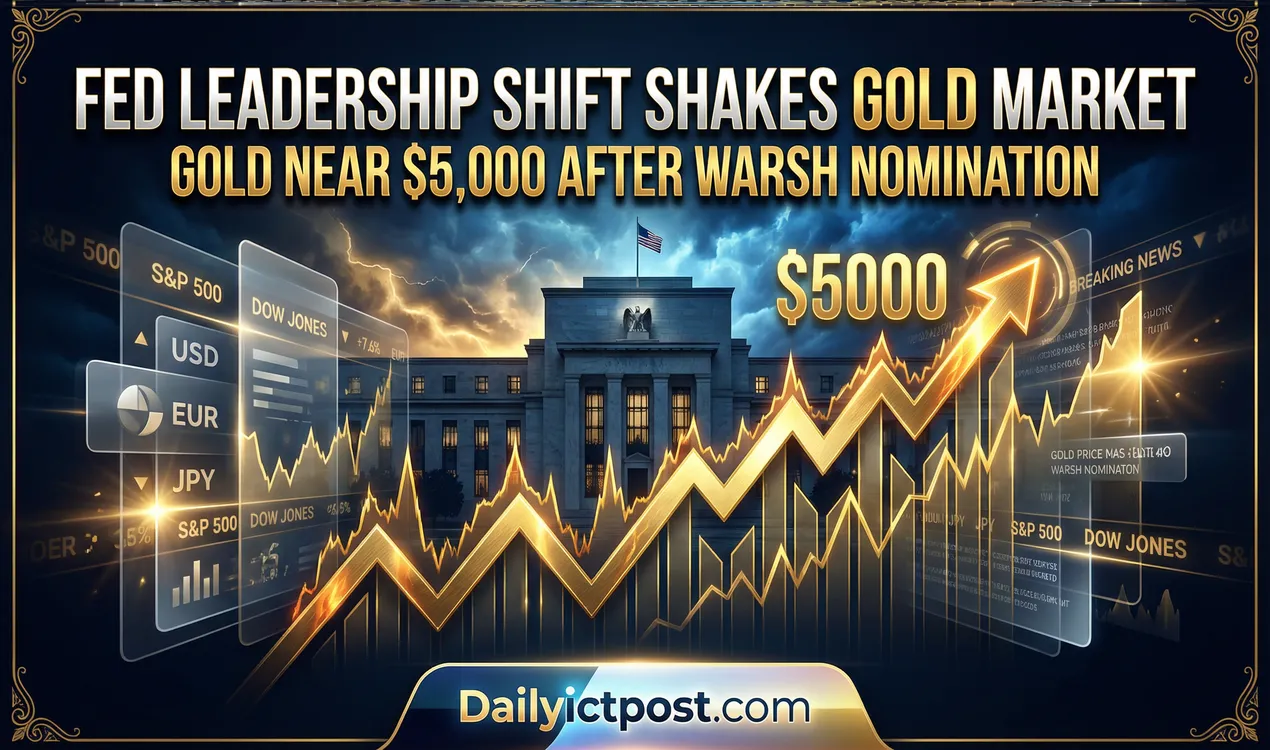
The financial world felt a genuine tremor on January 30, 2026. I remember staring at the charts when the news broke—President Trump’s nomination of Kevin Warsh to replace Jerome Powell didn’t just move the needle; it practically broke the gauge. If you’re holding gold or thinking about it, this moment is huge. It’s messy, it’s loud, and it’s exactly the kind of chaos where fortunes are made.
We are watching a massive clash of philosophies play out in real-time. Powell is out in May, and Warsh is likely in. The uncertainty of this transition is whipping the markets around like a ragdoll. But here is the thing about chaos: it breeds opportunity. With gold hovering near $5,000 and the big banks whispering about $6,300, understanding this fed leadership shift gold impact is one of the most critical decisions for gold investors in 2026.
Quick Answer:
The Fed leadership shift in 2026 increased gold volatility due to uncertainty over interest rates, dollar credibility, and political pressure—boosting gold’s safe-haven demand.
Think of the Federal Reserve as the engine room of a massive cruise ship—the global economy. When the captain changes in the middle of a storm, the passengers get nervous. That is exactly what is happening. The current fed leadership shift gold impact isn’t just about a new face in the office; it’s about a potential U-turn in how your money is managed.
Markets absolutely hate not knowing what comes next. The announcement itself sent ripples through every asset class. Traders are glued to their screens, trying to figure out if Warsh is going to be the tough guy we remember or the team player the White House wants. This tug-of-war is driving the daily price swings we are seeing.
You might know the name. Kevin Warsh isn’t a rookie. He was a Fed Governor back during the 2008 financial meltdown. Back then, he was the guy in the room warning about “easy money.” He wanted tighter control. He didn’t like printing money to solve every problem.
But people change, and so do circumstances. His recent alignment with President Trump suggests a pivot. We know Trump wants lower rates to boost growth. If Warsh decides to play ball and cut rates aggressively, we are looking at a whole new landscape. This split personality—hawk by history, dove by association—is what is confusing the algorithms and fueling the gold impact of fed leadership change.
Jerome Powell’s Exit: The End of an Era
Jerome Powell is leaving behind a complicated legacy. He steered us through the COVID crash and then had to fight the inflation monster he helped create. His motto, “higher for longer,” kept a lid on gold prices for a long time because it made the dollar strong.
His departure in May 2026 is the closing of a chapter. The markets are already trying to guess what the next chapter looks like. The fed leadership change effect on gold is partly relief from investors who felt Powell was choking the economy, and partly fear about the unknown.
Immediate Market Reaction to the Announcement
I watched gold take a nosedive on Friday, January 30. It fell from those dizzying heights near $5,600 down to below $5,100. It felt brutal. But why did it happen? Simple: profit-taking. The “smart money” used the headline as an excuse to cash out after a massive rally.
This is a classic “sell the news” event. It doesn’t mean the bull run is over. The immediate gold market reaction to fed leadership was negative on the charts, but the fundamental reasons to own gold haven’t changed one bit. In fact, they might have gotten stronger.
Fed Leadership Shift Gold Impact: The Real Analysis
Let’s get into the weeds. The fed leadership shift gold impact isn’t just about interest rates percentages. It is about credibility. The Federal Reserve’s superpower is trust. If the market starts to think the Fed is just doing whatever the President asks, the trust in the dollar evaporates.
When people stop trusting paper money, they run to gold. This transition is a massive stress test for the US Dollar. A weaker dollar under a new, politically pressured leadership would act like rocket fuel for precious metals.
Why Gold Dropped 4% Post-Announcement
Let’s be precise about that drop. Gold fell because algorithms read “Kevin Warsh” and their historical data said “Hawk.” They sold because they expected him to raise rates or keep them high. But human traders are starting to see it differently. The political context screams “rate cuts.”
This disconnect between what the bots are doing and what thinking humans are doing has created a buying window. The dip was sharp, sure, but I believe it is temporary.
The “Debasement Trade” Thesis
Here is the term you need to know: The Debasement Trade. Investors are buying gold because they are terrified the dollar is being watered down. The US debt is skyrocketing. The fed leadership change effect on gold amplifies this fear because a politically motivated Fed might just print more money to pay the government’s bills.
You buy real assets like gold and silver when you expect your cash to lose value. A leadership shift often hits the gas pedal on this fear.
Historical Context: Fed Chairs and Gold Prices
History rhymes, doesn’t it? When Paul Volcker took over in 1979, he crushed inflation, and gold went into a bear market for decades. When Ben Bernanke took the wheel in 2006, his policies eventually helped gold rally after the 2008 crash.
New chairs bring new risks. The gold prices after fed leadership shift usually see a lot of volatility in the first six months. The markets like to test the new guy. 2026 is going to be a wild ride.
Gold Impact of Fed Leadership Change on Interest Rates
Interest rates are like gravity for gold. High rates pull gold prices down because gold doesn’t pay you interest to hold it. Low rates let gold fly. The fed policy leadership shift gold prices relationship is the most reliable correlation in this market.
If Warsh cuts rates to 3%, as some analysts are whispering, the cost of holding gold drops to zero. Real rates—that’s the interest rate minus inflation—could turn deeply negative. That is the perfect storm for a massive rally.
The Trump Factor: Political Pressure on the Fed
We can’t pretend politics doesn’t matter. President Trump has been loud about his dislike for Powell’s policies. He wants a “yes-man.” If the market sniffs out that Warsh is just a puppet, the gold market reaction to fed leadership will be incredibly bullish.
Independence is the only thing that gives the Fed power. Losing it means inflation expectations get unanchored. And what is the best hedge against unanchored inflation? You guessed it. Gold.
Fed Leadership Change Effect on Gold Volatility
Volatility is back with a vengeance. The VIX is creeping up. The fed leadership transition gold outlook suggests we are going to see wide price swings. We might see days where gold moves $200 in a single session.
Traders love this action. Investors usually hate it. But if you are holding for the long haul, you have to ignore the noise. If you are trading, this is paradise.
Gold Prices After Fed Leadership Shift:
For the first quarter of 2026, expect things to be choppy. Gold needs to digest that 4% drop. It’s trying to find its feet. Support is sitting right at $5,000. Resistance is tough at $5,250.
The gold price impact of fed leadership change will likely keep us in this range until Warsh is actually confirmed by the Senate. Any drama in the confirmation hearings will spike uncertainty, and gold prices will likely jump.
Long-Term Outlook: $6,000 by Year-End 2026?
The big banks are not shy right now. JP Morgan raised its target to $6,300. Why? Because the structural issues—debt, war, countries moving away from the dollar—are getting worse, not better.
The leadership shift is just the match. The pile of wood is the global economic condition. A $6,000 target is actually conservative if the dollar index breaks below 100.
Let’s break down how policy shifts actually move the metal.
When the Fed is Hawkish (High Rates): The dollar gets strong. Gold usually struggles.
When the Fed is Dovish (Low Rates): The dollar weakens. Gold tends to fly.
When the Fed is Uncertain: This is where we are now. Volatility spikes, and people buy gold as a safe haven.
Currently, we are in that “Uncertain” phase, transitioning to “Dovish.” Both are positive for the fed leadership uncertainty gold rally.
Gold Market Reaction to Fed Leadership Uncertainty
Uncertainty is the keyword of the year. We don’t really know Warsh’s game plan. We don’t know if he will fight inflation or try to prevent a recession at all costs.
This unknown makes holding cash risky. Investors park capital in gold when they can’t read the room. The gold as hedge after fed leadership shift narrative is what is driving flows into ETFs right now.
Central Bank Buying:
While we are all watching the Fed, China and India are quietly backing up the truck. Central banks bought over 1,000 tons of gold last year. They see the chaos coming.
They are diversifying away from the dollar. The fed leadership shift market impact on gold just proves they are right. They fear US sanctions and US policy unpredictability.
Fed Leadership Transition Gold Outlook for Investors
So, what should you actually do? First, don’t panic sell. The gold prices amid fed leadership transition are testing your guts.
If you don’t have enough gold, this dip is a gift. If you are already full, just hold on. The reasons gold went to $5,000 haven’t disappeared.
Silver: The Volatile Sibling’s Reaction
Silver is like gold on energy drinks. It moves twice as fast. It fell 8% when gold fell 4%. But when gold rallies 5%, expect silver to jump 10%.
The fed leadership change gold forecast implies an even wilder ride for silver. Plus, industry actually needs silver for solar panels and AI chips, which puts a floor under the price that gold doesn’t have.
Gold Price Impact of Fed Leadership Change on ETFs
ETFs like GLD and IAU are seeing money move in and out fast. Institutional money is repositioning.
Watch the volume. If you see high volume on days when the price drops, it suggests people are giving up. If you see high volume on days price goes up, it means they are committed. Right now, we are seeing people buying the dips.
Fed Leadership Uncertainty Gold Rally Scenarios
Here is how this could play out:
Scenario A: Warsh gets confirmed quickly and cuts rates. Gold soars to $6,000.
Scenario B: The Senate blocks Warsh. Chaos ensues. Gold spikes on fear.
Scenario C: Warsh turns into a Hawk. Gold corrects to $4,800 before rebounding.
Most betting markets are leaning toward Scenario A.
Gold as Hedge After Fed Leadership Shift
Your portfolio needs insurance. The old 60/40 portfolio of stocks and bonds failed in 2022. It might fail again in 2026 if inflation comes back.
Fed leadership shift safe haven gold buying is basically insurance against the Fed making a mistake. If the new Chair screws up, your gold allocation pays for the losses elsewhere.
Fed Leadership Shift Market Impact on Gold Mining Stocks
Miners have been lagging behind the metal itself. Stocks like GDX and GDXJ look cheap relative to gold at $5,000. A stable leadership transition could finally unleash a rally in mining stocks.
Their operating margins are getting better. The gold volatility fed leadership change scares general investors away from miners, leaving value for the specialists who know what they are looking for.
Geopolitical Tensions Adding Fuel to the Fire
The Fed isn’t the only game in town. The Middle East is still a mess. Ukraine is still in conflict. Tensions in the South China Sea are rising.
Gold feeds on fear. The fed leadership shakeup gold analysis has to account for these external shocks. The Fed cannot fix geopolitics with interest rates.
If you watch the charts, here are the numbers to tattoo on your arm:
Pivot Point: $5,071
Support 1: $5,000 (The psychological floor)
Support 2: $4,850 (The 200-day moving average)
Resistance 1: $5,250
Resistance 2: $5,600 (The all-time high)
A daily close below $5,000 would look ugly for the short term.
Fed Leadership Change Gold Forecast from Major Banks
JP Morgan: Bullish. They see $6,300.
Citi: Bullish. Target $5,500.
Goldman Sachs: Neutral/Bullish. Target $5,200.
The consensus is pretty clear. The trend is up. The gold outlook under new fed leadership is overwhelmingly positive across the big institutional desks.
Gold Investment After Fed Leadership Shift: Buying the Dip?
There is an old saying: “Buy when there is blood in the streets.” The 4% drop was a flesh wound, not a fatal blow.
Smart investors are layering in. They buy a little now, and more if it drops. The fed leadership shift inflation gold impact will likely manifest as a slow grind higher followed by a breakout.
Fed Leadership Shift Safe Haven Gold Appeal
Why is gold a safe haven? Because it has no counterparty risk. If the Fed fails, the dollar suffers. Gold doesn’t rely on anyone’s promise to pay.
During a leadership transition, promises are vague. Tangible assets provide certainty. This is why the gold prices react to fed leadership news with such sensitivity.
Experts agree that the “Fed Put” is back. The market believes the Fed will step in to save the stock market if it crashes.
This creates moral hazard. It creates inflation. It creates the perfect environment for gold. The leadership shift only reinforces this belief.
Gold Outlook Under New Fed Leadership: The “Warsh” Era
If confirmed, the Warsh era will be defined by the struggle between growth and inflation. Trump wants growth. The bond market fears inflation.
Gold sits in the middle, judging the outcome. The fed leadership shift inflation gold impact will be the scorecard for his tenure.
Fed Leadership Shift Inflation Gold Impact
Inflation is sticky. It hasn’t gone away. If the new Fed Chair relaxes the 2% target to 3%, gold will reprice instantly.
Accepting higher inflation is a form of default. It is a silent tax. Gold investors know this. They are front-running the inevitable acceptance of higher inflation.
Gold Prices React to Fed Leadership News:
Jan 30: Nomination announced. Gold drops.
Feb – Apr: Senate hearings. Volatility ensues.
May: Powell leaves. Warsh takes over.
June: First FOMC meeting under new Chair. The moment of truth.
Mark these dates. They are the mile markers for the fed leadership shift gold impact journey.
Conclusion:
The fed leadership shift gold impact is the story of early 2026. We are seeing a changing of the guard at the world’s most powerful financial institution. While the short-term price action might look scary, the long-term thesis for gold has never been stronger.
Debt is rising. Trust is falling. The Fed is in transition. These are the ingredients for a generational bull market. Whether you have been trading for years or just bought your first coin, keeping your eye on the gold market reaction to fed leadership is essential for protecting your wealth.
The fed leadership shift gold impact will likely define gold’s direction for the rest of 2026, making this transition one of the most important macro events for investors.”
Check out our other in-depth analyses at gold.dailyictpost.com/ to stay ahead of the market curves.
Questions & Answers
1. How does a Fed leadership shift directly impact gold prices? A leadership shift creates a cloud of uncertainty about future interest rate policies. Markets really dislike uncertainty, which often drives investors toward safe-haven assets like gold. However, if the new leader is perceived as “hawkish” (favors high rates), gold may initially drop, just as we saw with the Warsh nomination.
2. Why did gold drop 4% after the announcement of Kevin Warsh? Algorithmic trading systems and traders reacted to Warsh’s past history as a “hawk” who favored tighter money. They sold gold expecting higher interest rates, despite speculation that he may now favor rate cuts to align with President Trump.
3. What is the “Debasement Trade” mentioned in the article? The debasement trade is an investment strategy that anticipates the currency (USD) will lose value due to excessive money printing and government debt. Investors buy gold to preserve their purchasing power against this devaluation.
4. Will gold reach $6,000 in 2026? Many major banks, including JP Morgan, forecast gold could reach or exceed $6,000 by year-end 2026. This is driven by central bank buying, lower interest rates, and geopolitical instability.
5. How do interest rates affect the price of gold? There is an inverse relationship. When interest rates rise, gold (which yields 0%) becomes less attractive compared to bonds. When rates fall, the opportunity cost of holding gold drops, typically causing gold prices to rise.
6. Is gold a good investment during a Fed transition? Yes, historically, gold performs well during periods of institutional change and uncertainty. It acts as a hedge against potential policy errors made by the incoming leadership.
7. What are the key support levels for gold right now? The psychological support is at $5,000. Technical support sits around the 200-day moving average near $4,850. Holding above $5,000 is critical for the bullish trend to continue.
8. How does political pressure from the White House affect the Fed? If the Fed is seen as bowing to political pressure to cut rates for election or growth purposes, it loses credibility. This loss of independence typically leads to higher inflation expectations, which is very bullish for gold.
9. What should I do if gold prices keep fluctuating wildly? Maintain a long-term perspective. Volatility is normal during leadership changes. Avoid using high leverage and focus on accumulating positions during significant dips.
10. Where can I find more updates on this topic? You can follow financial news outlets and check regular updates on our website at gold.dailyictpost.com/ for the latest analysis on the fed leadership shift gold impact.
11. How does the fed leadership shift gold impact long-term gold prices?
A shift in leadership can influence gold long term by changing interest rate and inflation policy signals.
More dovish leadership (lower rates, easier money) usually supports higher gold prices, while hawkish leadership can pressure gold by strengthening the dollar and yields.
Please don’t forget to leave a review of my article.
The author at gold.dailyictpost.com focuses on educational research related to the global gold market and long-term economic trends. Their work is centred on explaining how gold prices behave over time and how broader economic factors such as inflation, interest rates, and central bank policies influence the gold market.
Rather than offering investment advice, the author analyses historical data, publicly available economic reports, and well-documented market behaviour to help readers understand gold as a financial asset. The goal is to make complex financial topics easier to understand using clear language and real-world context.
The author’s writing approach is research-driven and neutral. Articles are written to inform, not to persuade. No content is intended to encourage buying, selling, or holding any specific asset. All discussions remain educational and are framed around historical trends and widely accepted economic principles.
gold.dailyictpost.com maintains editorial independence. The author does not promote paid investment schemes, financial products, or brokerage services. Any advertisements displayed on the website are handled by third-party networks and do not influence editorial decisions.
Readers are encouraged to use the information provided as a learning resource and to consult licensed financial professionals before making any financial decisions.